
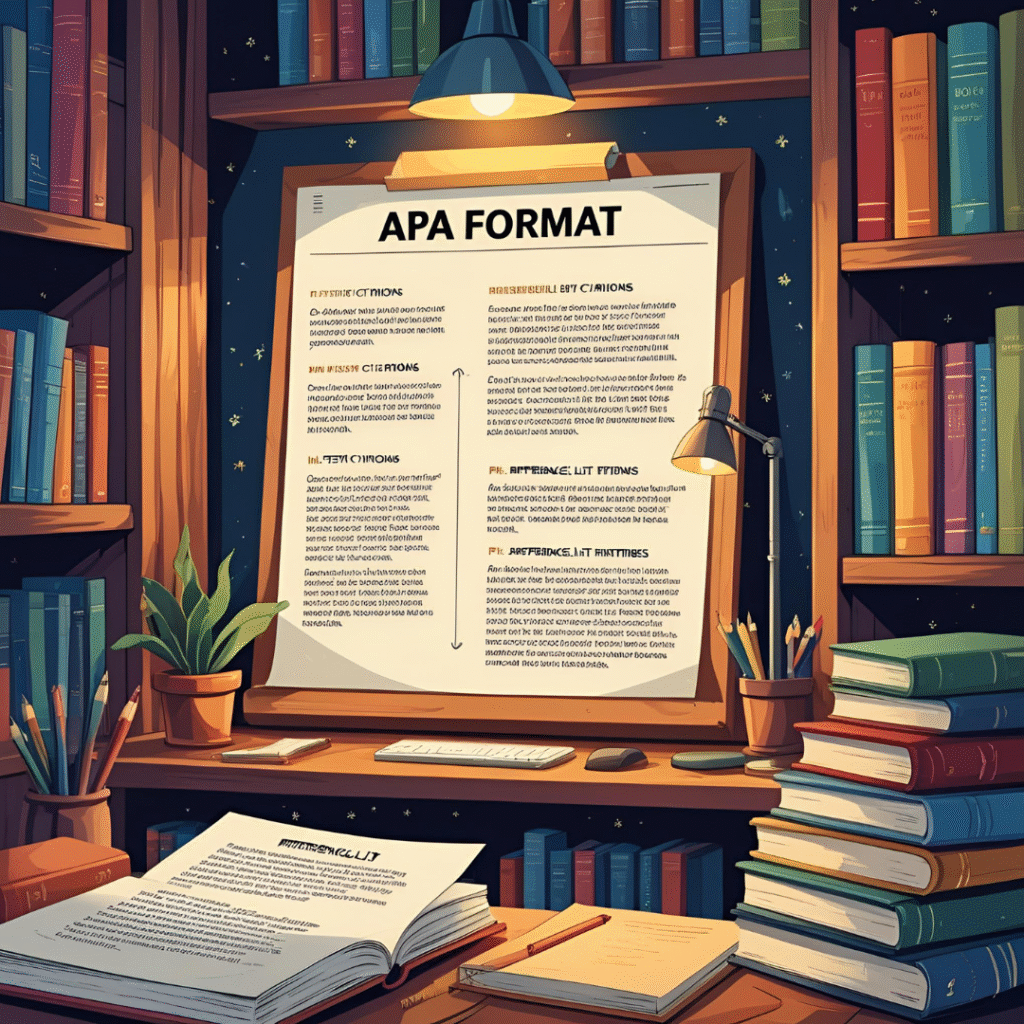
Introduction: Why APA Format Matters
In the academic and professional writing world, APA (American Psychological Association) format is the gold standard for presenting research and scholarly work in a clear, uniform manner. It’s not just about aesthetics—it enhances readability, ensures proper attribution, and promotes ethical research practices (American Psychological Association, 2020).
The 7th edition of the APA Publication Manual, released in 2019, modernized guidelines to accommodate diverse sources like podcasts, social media, and online videos, reflecting how information is accessed today.
Key Principles of APA Formatting
General Document Format
- Margins: 1 inch on all sides
- Font: Acceptable fonts include 12-pt Times New Roman, 11-pt Arial, or 11-pt Calibri
- Spacing: Double-spaced throughout (including references)
- Alignment: Left-aligned text, with a ragged right edge
- Page numbers: Top right corner
Consistency in formatting is crucial for professional presentation and reader comprehension.
Title Page Essentials
The 7th edition simplified the title page, which now typically includes:
- Paper title (bold, centered, title case)
- Author’s name
- Institutional affiliation
- Course number and name
- Instructor’s name
- Due date
For professional manuscripts, a running head is required, but student papers no longer need one unless specified.
Headings and Subheadings
APA organizes content with a five-level heading structure:
- Level 1: Centered, Bold, Title Case
- Level 2: Left-aligned, Bold, Title Case
- Level 3: Left-aligned, bold italics, Title Case
- Level 4: Indented, bold, Title Case, ending with a period. Text follows on same line.
- Level 5: Indented, bold italics, Title Case, ending with a period. Text follows on same line.
Headings make longer papers more navigable and reader-friendly.
In-Text Citations
APA 7th uses the author-date citation system:
- Paraphrase: (Author, Year) e.g. (Smith, 2022)
- Direct quote: (Author, Year, p. Page) e.g. (Jones, 2021, p. 45)
Multiple authors:
- 2 authors: (Smith & Brown, 2022)
- 3+ authors: (Martin et al., 2020)
Citations maintain academic integrity and help readers trace your sources.
Reference List Rules
Key rules for creating a reference list:
- Titled “References,” centered, bold
- Double-spaced entries
- Hanging indent (0.5 inch)
- Alphabetical order by author surname
Example:
Lee, J. S., & Kim, R. L. (2023). Writing in the digital era. Journal of Academic Writing, 28(3), 210–223. https://doi.org/10.1234/jaw.2023.5678
Common Mistakes to Avoid
- Mixing up “et al.” rules for in-text citations
- Omitting DOIs for journal articles when available
- Forgetting hanging indents in references
- Capitalizing article titles incorrectly (APA uses sentence case)
Small errors can lead to lower grades or rejected manuscripts.
Tips for Mastering APA Style
- Use the official APA website for the latest guidance.
- Utilize citation tools—but double-check their accuracy!
- Refer to sample papers provided by the APA.
- Keep the Publication Manual of the American Psychological Association, 7th Edition nearby.
Mastering APA takes practice but boosts your professional writing credibility.